Every issue is a new revision
Documents are append-only. Superseded revisions stay readable and stay marked, so nobody builds from a drawing that was replaced last Thursday.
Document control · ISO 19650-aligned
Issue.Prove.Hand over.
aptEDMS keeps controlled documents straight: every revision, review, transmittal and retention rule in one register. Built for engineering and capital projects, and for any organisation that has to answer an auditor with more than a shared drive and a good memory.
Live demo · no sign-up · a sample EPC project with documents, reviews and transmittals in it
The lifecycle
Every issue is a new revision, never an overwrite. The register knows which state a document is in and who is holding it; the audit trail records how it got there and cannot be edited afterwards.
The author's own copy. Nobody outside the originating team can see it, and no revision has been issued yet.
Not only drawings
If it carries a revision, an approval and a record of who received it, aptEDMS handles it the same way, whether it is a general arrangement or a calibration certificate.
General arrangements, P&IDs, isometrics and 3D models, viewed and marked up in the browser.
Datasheets, calculations, method statements and studies, with the text itself indexed for search.
Operating procedures and management-system documents, with retention rules and periodic review.
Test, calibration and inspection records: the evidence a handover pack or an audit is built from.
Capabilities
Documents are append-only. Superseded revisions stay readable and stay marked, so nobody builds from a drawing that was replaced last Thursday.
Named reviewers, due dates counted in working days, automatic reminders, and cover for anyone who is away. Comments come back consolidated into one response.
Issue a set as a transmittal against a distribution matrix, sealed as a ZIP with a hash over the manifest, so what arrived can be checked against what was sent.
Full-text search across numbers, titles, disciplines and extracted text, weighted so a document number matches first. Saved views and bulk edit for the rest.
Revision clouds, callouts, stamps, layers and calibrated measurement and take-off, in the browser. Markups are saved against the revision they were drawn on.
Build a report by dragging fields, schedule it, and export to PDF or Excel. Overdue reviews, progress by discipline and issue history come as standard.
Retention rules, legal hold, and a companion-PDF rule so a file is still openable years later. Checksums are verified on a sweep, not just at upload.
Per-project roles enforced by the database itself, not just the interface. Single sign-on, SCIM provisioning and two-factor authentication.
What it looks like
Three screens from the demo that is linked at the top of this page, not a rendering and not a concept.
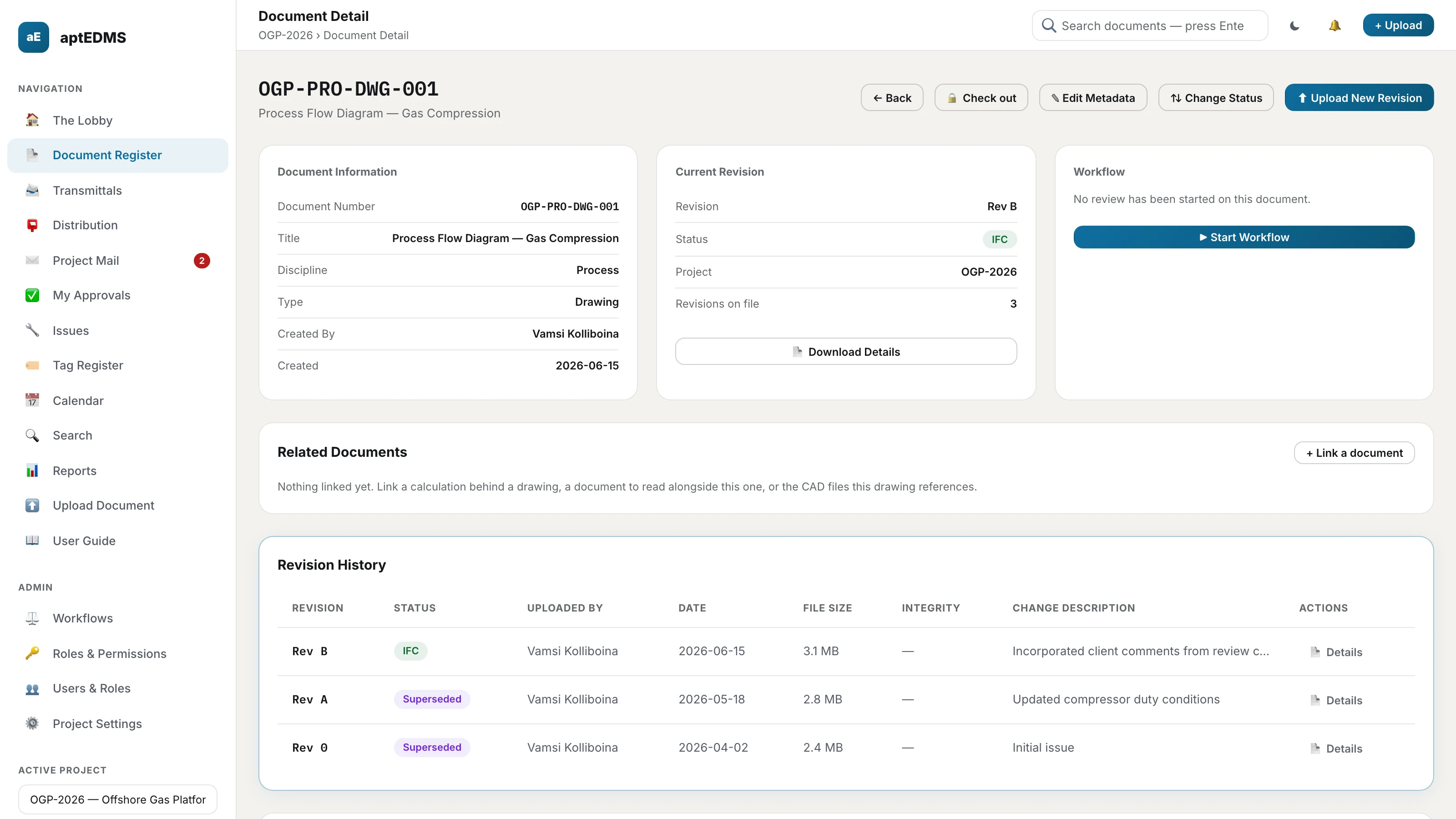
Rev B, IFC, 3.1 MB, uploaded by name and date, against the change that caused it: “Incorporated client comments from review cycle 2.” The integrity column carries the checksum.
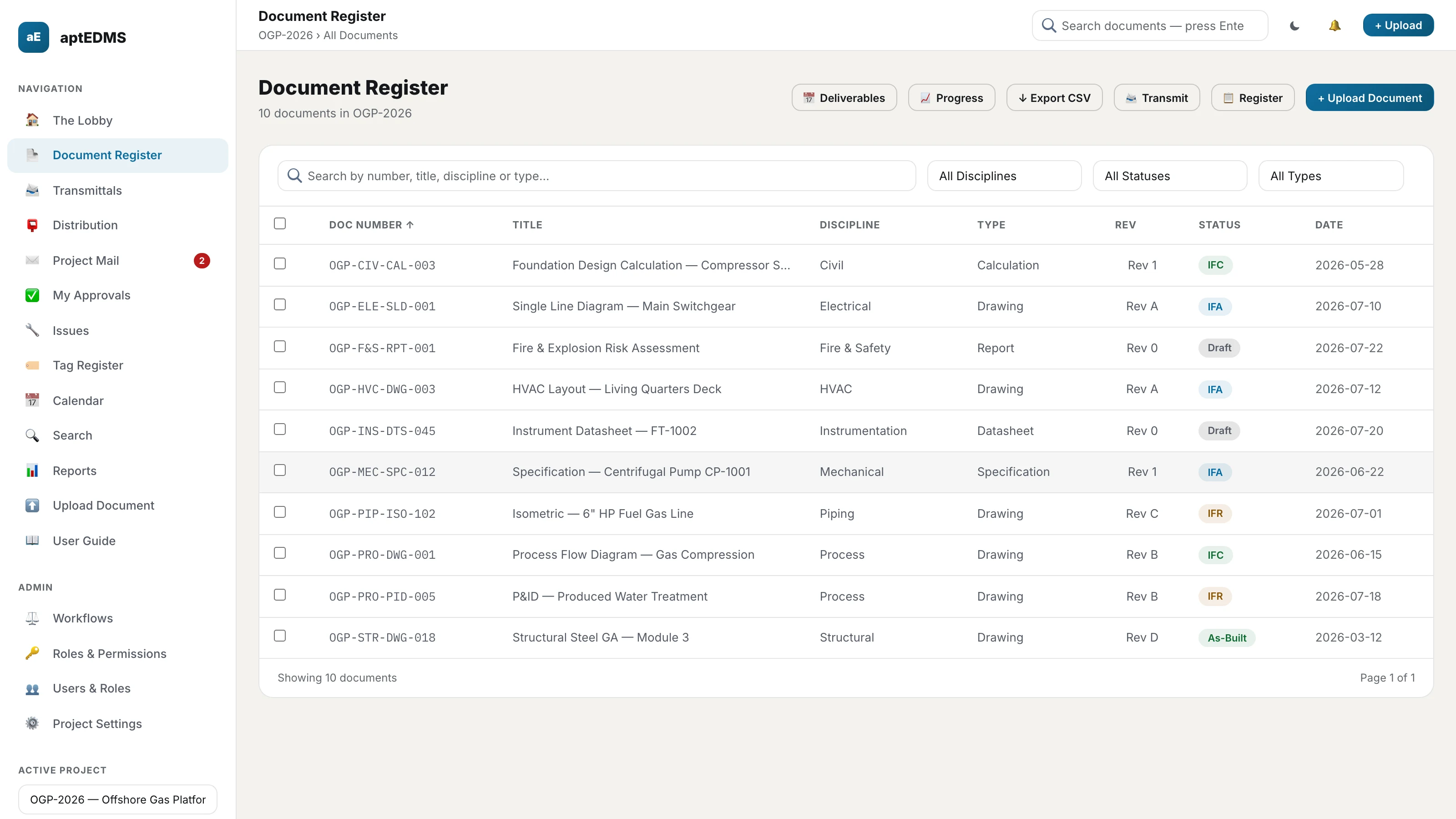
Discipline, type, revision and status are columns you filter, not a naming convention you have to remember and a folder tree you have to trust.
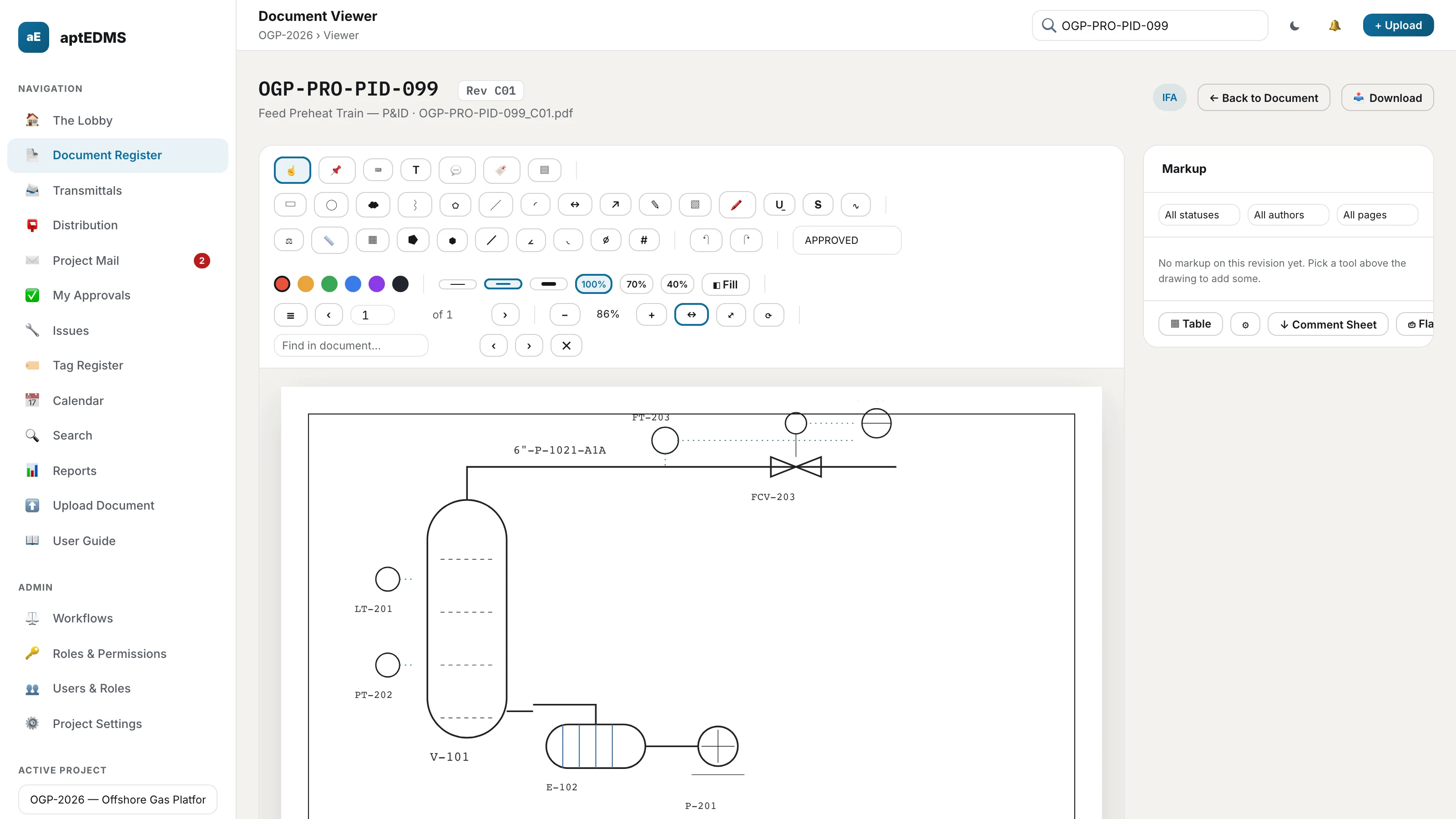
Comment, measure and stamp in the browser. Markup is anchored to the revision it was made against, so it never silently reattaches to a drawing nobody reviewed.
Assurance
Most systems in this market say “compliant” and leave it there. aptEDMS publishes the clause-by-clause assessment instead, including the clauses it does not meet yet, in the same voice as the ones it does.
A claim you can check is worth more than a claim you have to believe.
Against the field
Every other comparison table uses filled and empty circles. We control documents for a living, so this one is marked in review codes, and the same hand marked us.
| Capability | aptEDMS | Aconex | Asite | FusionLive | Procore | ACC | e-Builder |
|---|---|---|---|---|---|---|---|
| Status transitions enforced in the database The database refuses an illegal transition; it is not a rule in application code | A | C | C | C | C | C | C |
| Append-only audit trail No UPDATE or DELETE policy for any role, administrators included | A | B | B | B | B | B | B |
| Reviewers and recipients cost nothing You pay only for the people who upload, issue and approve | A | B | C | B | A | C | B |
| Price published A figure anyone can read, without a sales call. B means it is published only on a government framework, not by the vendor. | A | B | A | B | C | B | C |
| SHA-256 integrity on every revision | A | B | B | B | C | B | C |
| ISO 19650 naming validation Not built. The standards section says so too. | C | A | A | A | B | A | B |
| Desktop CAD sync agent Not built. | C | A | B | A | B | A | B |
| Virus scanning on upload Not built. | C | A | A | A | A | A | A |
Three of those C’s are ours. We would rather you found them here than three weeks into an evaluation. The reasoning behind every mark is on the comparison page.
Who it is for
Oil, gas, petrochemical and renewables, from FEED through commissioning to operations.
Asset owners running long capital programmes alongside a live operational estate.
Multi-party projects where the question is always which revision the contractor built to.
Plants where a procedure, a change record and a calibration certificate are all controlled documents.
Organisations with statutory retention and a duty to produce records on request.
Firms issuing to many clients at once, each with its own numbering and distribution rules.
Pricing
One price per project, however many people work on it. Controllers, reviewers, the client’s engineers, the supply chain: everybody gets a login, because a common data environment with people missing from it is not one.
The meter follows our costs, and our costs move with documents, not people: storing a drawing costs something; a reviewer opening it costs close to nothing. A price per seat taxes the exact behaviour the product is sold on. Worse, it invites shared logins, and a shared login quietly breaks the one thing an audit trail is for: knowing who did what.
From £400 a month
Unlimited users · 1 TB of documents · invoiced, purchase orders welcome
There is no Professional edition and no Enterprise edition. The price moves with the project; the product does not move at all.
And before any conversation: the demo opens without a sign-up and stays open, with every feature switched on and nothing kept back for a sales call.
This market prices three ways. Per seat, everyone billed: Asite publishes £15–£60 a user; FusionLive’s G‑Cloud filing runs £35 down to £19 with a 25‑licence minimum. Per project: Trimble’s filing runs £300 to £5,000 a month by project value, unlimited users. And quote‑only: Aconex, Autodesk and Bentley publish no price at all. We price the second way, because that is where the costs actually are — and we publish it.
Competitor figures are each vendor’s own published rate card: Asite’s pricing page, Idox’s G‑Cloud filing (May 2024) and Trimble’s G‑Cloud filing (December 2025). We have quoted them rather than characterised them, as at the dates shown; if one has moved, this page is wrong until we fix it, and we would like to know.
Bentley ProjectWise
£44,364 a year
Minimum, per data centre, before a single named user. A “Validate” seat is £1,670 a year on top.
Autodesk Construction Cloud
15–30% dormant
Assigned seats are billed whether or not the person ever signs in.
aptEDMS
£400 a month
One project, everyone on it. No seat floor, no data-centre floor, no implementation fee, no dormant-seat bill: a seat cannot be dormant, because seats are not the meter.
Billed per project, month to month, with setup included. If you leave, your register exports to CSV and your documents download as they went in: originals, revisions and the audit trail. Nothing you issued stops being provable because you stopped paying.
Worth checking against whoever else you are considering. FusionLive’s published terms reserve “a reasonable fee for the retrieval and delivery of the Licensee’s data”; Trimble’s Viewpoint For Projects lists end-of-contract extraction at £1,750 per project. Leaving is a priced event almost everywhere in this market. It is not here.
Questions we get asked
Nobody needs a licence individually. A project is priced as a project, and everyone working on it signs in under it: controllers, reviewers, the client, the supply chain. And someone who only needs to verify a sealed transmittal needs no account at all, ever: verification that depended on our cooperation would not be verification.
Probably not, and the price is built for that. A laser-scan campaign on one offshore platform can run past a terabyte on its own, and a federated design model republished weekly for two years leaves a long revision history, which we keep, all of it, because a register that quietly discards old revisions is not a register. The first terabyte is included and is sized for the controlled register itself: drawings, documents and published models. Beyond it, storage is priced per terabyte and agreed before you commit to anything, never per person, and never as a surprise on an invoice. Tell us what you are storing and we will put a number on it.
Access is enforced in the database, not the application. Every query runs under PostgreSQL row-level security tied to your identity, so a bug in the API cannot return a document you are not entitled to — the database refuses before the application gets the chance.
Revisions and workflow actions are append-only at the database level. There is no UPDATE or DELETE policy on those tables for any role, administrators included. An override is a new row recording who overrode what and why, never an edit to the old one.
Export the register to CSV and download every document, revision and audit entry. Both are free, and neither waits on a final invoice.
Partly, and the standards section says exactly which clauses are not met yet. Naming validation is not built. We would rather you knew now.
Try it
The demo runs on a sample project with documents, revisions, reviews and transmittals already in it. Nothing to install, nothing to sign up for.
No sign-up · nothing to install